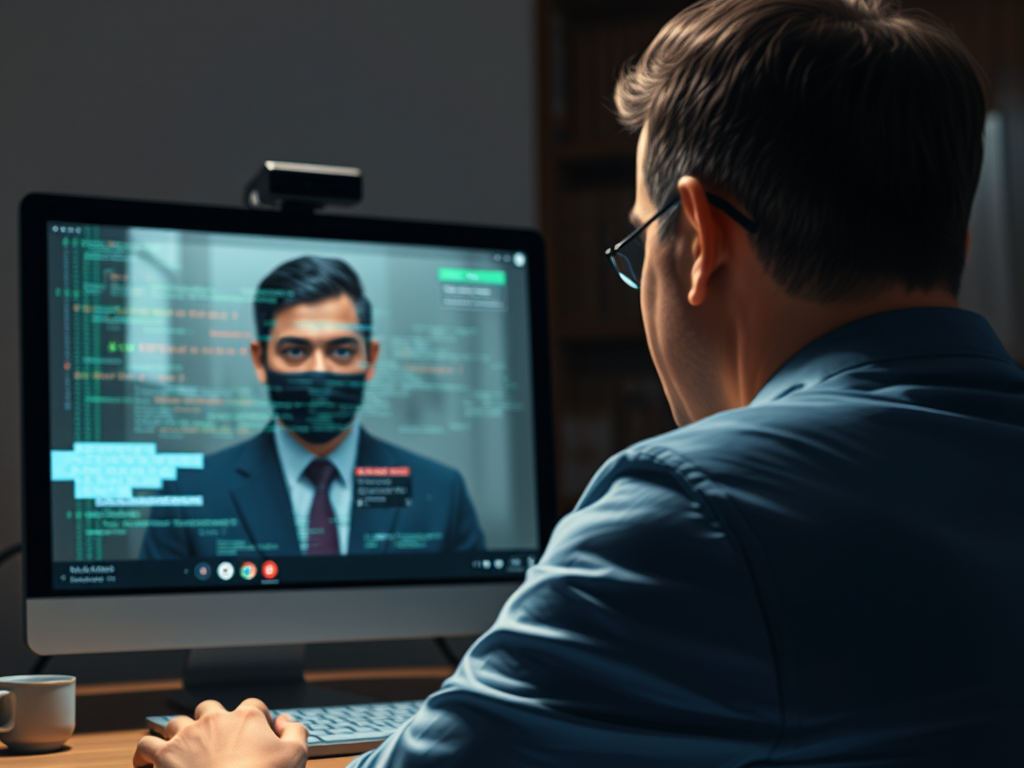
A friend of mine—let’s call him Kevin—was interviewing a developer candidate over Zoom.
The candidate joined the call and opened with something unexpected:
“Before we begin, I need to tell you—I’m not the person on the resume.”
He explained that he’d been hired by a placement company to impersonate someone else. The resume was fake. The identity was fake. The entire process was engineered. His job was simple: show up to interviews, get hired, and collect a cut while the agency pocketed placement fees.
And here’s the part that should concern all of us:
He was getting through interviews.
Not because he was qualified.
Because he had help.
The New Interview Assistant
This wasn’t someone memorizing answers or bluffing their way through.
He was using AI.
Tools now exist that can:
- Listen to interview questions in real time
- Analyze the question against a resume
- Generate polished, conversational answers instantly
Not after the interview. During it.
And it’s working.
Roughly 39% of candidates are already using AI in the application process, and 6% admit to outright interview fraud—impersonation or substitution
What used to be preparation has quietly become augmentation.
And in some cases, replacement.
From Optimization to Exploitation
For years, we’ve encouraged candidates to “use the tools available.”
- Use AI to refine your resume
- Use AI to prep for interviews
- Use AI to practice coding problems
That was the shift.
But now we’re seeing the next phase.
AI isn’t just helping candidates present themselves better—it’s helping them be someone else entirely.
- AI-generated resumes tailored to beat screening systems
- Deepfake video and voice to pass interviews
- Synthetic identities built in minutes
- Real people acting as proxies for fake ones
What used to require a coordinated fraud operation now requires… a browser and a prompt.
This Isn’t Edge Case Behavior
It’s becoming systemic.
- Experts predict 1 in 4 candidates could be fake by 2028
- AI-powered hiring fraud is now described as “scalable” and industrialized
- Organizations are already reporting fake applicants successfully landing jobs
And this isn’t just about bad hires.
In some cases, fake candidates are being used to:
- Access internal systems
- Steal intellectual property
- Deliver malware during technical interviews
Let that sink in.
The interview process itself is becoming an attack vector.
The Real Problem: Trust Is Breaking
For decades, hiring has operated on a set of assumptions:
- The person on the call is the person on the resume
- The answers reflect the candidate’s knowledge
- The interview evaluates the individual
Those assumptions are no longer safe.
AI has quietly eroded each one.
We didn’t just introduce a new tool into hiring.
We introduced a way to bypass its core premise.
The Tension No One Talks About
Here’s the uncomfortable reality:
We want candidates to use AI.
We expect it, even.
But we don’t want:
- AI answering instead of the candidate
- AI masking a lack of competence
- AI enabling identity fraud
So where is the line?
Because right now—it’s blurry.
So What Do We Do?
This isn’t a call to panic. It’s a call to adapt.
Some shifts are already becoming obvious:
1. Interviews need to evolve
Less trivia. More reasoning. More “show me how you think.”
2. Identity matters again
Basic verification—something we took for granted—is now critical.
3. AI use should be surfaced, not hidden
The best candidates won’t pretend they aren’t using AI. They’ll explain how.
4. Trust needs to be rebuilt intentionally
Because it’s no longer implicit.
The Part That Stuck With Me
Back to Kevin’s story.
The candidate—“Steve”—had a choice.
He could have continued playing the game. He could have taken the job, collected the check, and moved on.
Instead, he told the truth.
And he said he’d started doing that in every interview.
Because even he realized something was off.
Final Thought
We’ve spent years optimizing hiring for speed, scale, and efficiency.
AI just optimized it for deception.
The question isn’t whether candidates are using AI anymore.
It’s whether you’re still interviewing a human.